Product update
FlowBuddy Expands AI-Assisted Process Architecture and Design
FlowBuddy adds an AI Process Architect that turns standards, enterprise materials, and templates into editable process architecture, documents, and diagrams.
Beyond diagram drawing
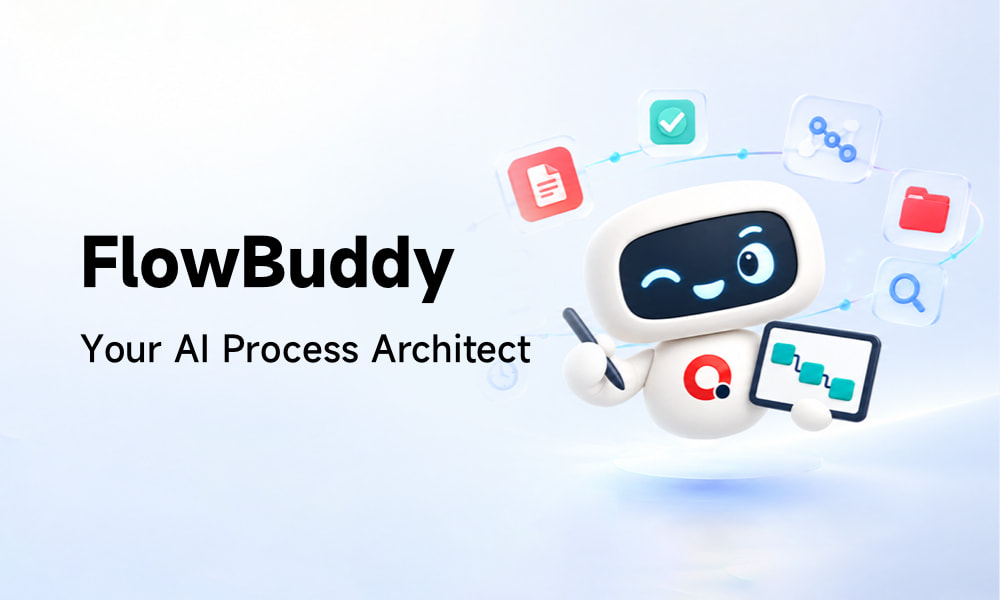
Enterprise process work is broader than drawing a diagram. Teams must reconcile industry references, the company process framework, policies, responsibilities, documents, diagrams, and eventual delivery. When those activities are separated, the framework and processes drift apart, documents disagree with diagrams, and business boundaries are confirmed again and again.
FlowBuddy's AI Process Architect supports the complete chain: understand the scope, plan the framework, design the process, identify questions for confirmation, and deliver reusable results.
Use references, not copies
For framework planning, the AI Process Architect can use references such as the APQC Process Classification Framework together with industry examples and the company's existing process system. Teams can query references by industry, scope, name, or number, or describe a business need in natural language and review candidate suggestions, reasons, and sources.
A reference is not copied into the enterprise framework. The company edits and adapts the result to its own responsibilities, business model, and management requirements.
Connect framework and detailed design
A process framework explains where a process belongs, its boundary, and its relationships. Detailed design defines who performs the work, the rules they follow, inputs and outputs, and how the process finishes. The AI Process Architect carries context from the framework into detailed design and can suggest a framework location when work starts from a single process.
If the framework later changes, existing process results are not silently overwritten. The change is highlighted for people to decide whether and how to update the design.
Enterprise templates and editable results
Companies define different document standards: required sections, responsibility tables, input-output tables, diagram conventions, and delivery formats. The AI Process Architect can learn those structures from sample Word, PDF, or text files, while policies, process materials, and business descriptions provide the facts for the current design.
The output is a process document and an editable diagram built from the same process semantics—names, activities, roles, inputs and outputs, branches, risks, and controls. The diagram remains a design artifact that people can adjust rather than a fixed AI-generated picture.
Confirm open questions, then deliver
When owners, approval conditions, business rules, or source materials are missing or ambiguous, the AI Process Architect records them as confirmation items tied to the related content. Necessary checks separate generated content from content the enterprise has approved.
After confirmation, results can be delivered as local files, archived in an enterprise knowledge base, or transferred to AlphaFlow EBPA for continued lifecycle management. The AI prepares and structures the work; people make the key business decisions.
Further reading
Original announcement