Alphaflow helps draft CAICT new process management platform standard

Author: AlphaFlow Team Times: Apr 17, 2026 Views:101

Executive Summary

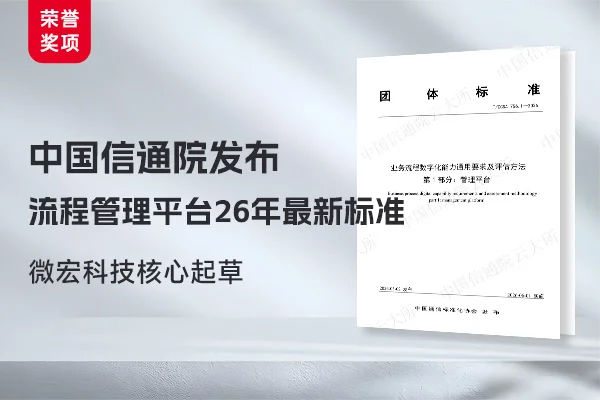
CAICT has released the 2026 update of General Requirements and Evaluation Methods for Business Process Digitalization Capability. Part 1: Management Platform further strengthens business process lifecycle management, introduces and emphasizes process planning and design together with AI process capabilities, and accelerates the evolution of BPM platforms from process execution tools to foundational platforms for process governance and intelligence.

The group standard T/CCSA 756.1-2026, General Requirements and Evaluation Methods for Business Process Digitalization Capability - Part 1: Management Platform, issued by the China Communications Standards Association (CCSA), has been officially released and will take effect on June 1, 2026. AlphaFlow Technologies participated in drafting this standard as one of the principal drafting organizations.

This release is an important part of the General Requirements and Evaluation Methods for Business Process Digitalization Capability standard series. According to the foreword, the series currently includes: Part 1: Management Platform, Part 2: Process Mining Platform, Part 3: Process Governance Maturity, and Part 4: Process Intelligence.

Among these, Part 1 focuses on common capability requirements and evaluation methods for business process management platforms. It provides a unified reference for enterprise users planning, implementing, operating, and maintaining BPM platforms, for service providers designing and developing related products, and for third-party assessment institutions conducting evaluations.

The standard centers on management platforms and further strengthens the full-lifecycle capability framework

From the perspective of content, the newly released Part 1: Management Platform no longer defines BPM platforms only in terms of process engines or execution. Instead, it sets requirements from a more complete platform perspective.

The standard clearly states that BPM platforms should include the following baseline capabilities: process standards and specifications, business process lifecycle management, technology convergence and application, platform adaptability, platform operations and maintenance, and security capabilities.

In the capability overview, the standard specifically emphasizes that platform development should establish a complete business process management lifecycle, covering standards and specification management, indicator system management, process planning and design, process modeling, process execution, process monitoring, and process analysis.

This means the evaluation logic for management platforms is moving beyond whether a platform can run processes and toward whether it can support a complete closed loop from standardization, design, and execution to optimization.

A core update in this year's Part 1: process planning and design is clearly moved upstream

Compared with the industry's previous understanding of BPM platforms mainly from the dimensions of modeling, execution, monitoring, and integration, one distinctive feature of this year's standard is that process planning and design is explicitly incorporated into business process lifecycle management and positioned earlier in the lifecycle.

In Chapter 8, Business Process Lifecycle Management, Section 8.1 specifically lists Process Planning and Design and sets out a series of requirements, including:

  • Support visual end-to-end process design

  • Support online collaborative modeling across organizations, systems, and business processes

  • Support hierarchical process design, enabling decomposition from strategic objectives to operational steps

  • Support linked modeling between processes and business views such as organizational charts, policy maps, and data maps

  • Support process template management, version management, and query/statistics capabilities

  • Recommended support for multi-person collaborative design, process simulation, and rule checking

The significance of these requirements lies in shifting the focus of enterprise process management from how to run processes after go-live to how to plan, design, and govern processes before go-live.

This shift is highly important for enterprises. In the past, many organizations began process digitalization with approval flows, form flows, or isolated process automation. As process volumes and system complexity increased, issues often emerged, including inconsistent process standards, uncontrolled versions, weak cross-department collaboration, and misalignment between policies and processes.

By strengthening process planning and design, this standard effectively establishes a methodological foundation for enterprises: design first, then model, then run, then optimize.

From process modeling + execution to standardization + governance + optimization

In addition to process planning and design, this standard also defines business process lifecycle management in a more complete way.

In Chapter 8, lifecycle management is explicitly broken down into:

  • Process planning and design

  • Process modeling

  • Process execution

  • Process monitoring

  •  Process analysis

At the same time, Chapter 7, Process Standards and Specifications, proposes standards and specification management and indicator system management, with optional support for risk and control-measure management.

This indicates that management platforms are no longer merely workflow systems or approval platforms, but integrated platforms that connect process standards, process indicators, process design, process execution, and process optimization.

From an industry development perspective, this reflects an upgraded role for BPM platforms: they are evolving from traditional process execution tools into foundational infrastructure for process governance and enterprise digital transformation.

AI capabilities are formally written into the management platform standard, signaling an important step in this upgrade

Another notable change in this year's standard is that AI capabilities are listed separately in Section 9.2.

In the Technology Convergence and Application chapter, in addition to integration capabilities, the standard specifically introduces AI capability requirements, including:

  • - Support process automation capability modeling

  • - Recommended support for integration with mainstream large AI models

  • - Recommended support for intelligent process recommendations such as node path prediction and task assignment suggestions

  • - Recommended support for intelligent process path selection and process anomaly recognition and analysis

  • - Recommended support for custom AI agents based on large AI models

In the security capability chapter, the standard also introduces requirements for AI security management.

This shows that AI's role in process management platforms has fundamentally changed.

AI is no longer just an add-on feature or a standalone assistant. It is now incorporated into the core platform capability framework and is expected to span key stages including process planning and design, process modeling, process execution, process monitoring, and process analysis.

Behind this shift is a broader trend: enterprise process digitalization is moving from online approval enablement toward process intelligence. As large models, AI agents, process automation, and process mining continue entering core business scenarios, market expectations for process platforms are also changing.

Enterprises now need more than platforms that simply run processes. They need platforms with stronger sensing, recommendation, analysis, and continuous optimization capabilities.

What do these standard updates mean for enterprises and the industry?

From the enterprise user perspective, this standard upgrade brings at least three implications.

First, the bar for BPM platform selection has been raised.

In future platform evaluations, enterprises will no longer look only at process engines, forms, and approval functions. They will also assess whether the platform offers comprehensive capabilities across standards and specification management, process planning and design, full-lifecycle management, technology convergence, AI capabilities, security, and operations and maintenance.

Second, process management platforms are becoming a critical foundation for enterprise digital transformation.

When process standards, policies, organizations, data, systems, and AI capabilities are addressed within one unified platform framework, the role of the process platform goes far beyond that of an approval tool and becomes key infrastructure for stronger management capability and higher operational efficiency.

Third, implementation pathways for AI in process scenarios are becoming clearer.

This standard does not discuss AI in abstract terms. Instead, it translates AI into specific capabilities such as process automation modeling, multimodal modeling, path prediction, task recommendation, anomaly detection, analytics report generation, and AI-agent applications.

This provides strong guidance for both product evolution across the industry and practical implementation in enterprises.

AlphaFlow Technologies contributes to standards development and continues to advance management platforms toward full-lifecycle capability and intelligence

As one of the principal drafting organizations, AlphaFlow Technologies has long focused on enterprise-grade process management platform development and has continuously advanced product R&D and practical innovation in process planning and design, process management, process optimization, and process intelligence.

Its participation in drafting General Requirements and Evaluation Methods for Business Process Digitalization Capability - Part 1: Management Platform demonstrates both the company's long-term accumulation in process platforms and its sustained investment in full-lifecycle process management, process standardization, process governance, and AI-enabled process capabilities.

Looking ahead, AlphaFlow Technologies will continue to drive product innovation and practical implementation in process planning and design, process management platforms, process analysis and optimization, and AI process capabilities.

The company remains committed to helping enterprises advance from process digitalization to process intelligence and to supporting both industry-standard implementation and enterprise digital transformation.

Standard Upgrade Highlights

  • General Requirements and Evaluation Methods for Business Process Digitalization Capability now includes four parts: Management Platform, Process Mining Platform, Process Governance Maturity, and Process Intelligence

  • Part 1: Management Platform was issued by CCSA on March 2, 2026 and will take effect on June 1, 2026

  • AlphaFlow Technologies is one of the principal drafting organizations

  • The standard further strengthens business process lifecycle management

  • Process planning and design is explicitly incorporated into lifecycle management and strongly emphasized

  • AI capabilities are set out in a dedicated section and become a key part of the management platform capability model

  • The management platform evaluation logic is upgraded from can run processes to can standardize, govern, optimize, and enable intelligence

News Tag: AlphaFlow
Original article, author: AlphaFlow Team, If reprinted, please indicate the source: Alphaflow helps draft CAICT new process management platform standard-www.AlphaFlowBPM.com

Recommended Company News

Alphaflow helps draft CAICT new process management platform standard
China Academy of Information and Communications Technology (CAICT) has officially released T/CCSA 756.1—2026 General Requirements and eva1uation Methods for Dig...
Company news
Apr 17, 2026
From Process Execution to Process Assets: How Leading Enterprises Scale EBPA and BPA
How leading enterprises scale process automation by combining BPA and EBPA with AlphaFlow.
Signing news
Mar 16, 2026
Meide Group Selects AlphaFlow to Build an Integrated Global Process Governance Platform
Meide Group partners with AlphaFlow Technologies to build an integrated global process governance platform.
Signing news
Mar 07, 2026